How do I implement a cancellable, backpressure-aware Transform stream for async iterators?
Use Node’s stream contract to build a Transform that processes async-iterator input, pauses when write() applies backpressure, and cancels with an observable error instead of leaving buffered work behind.
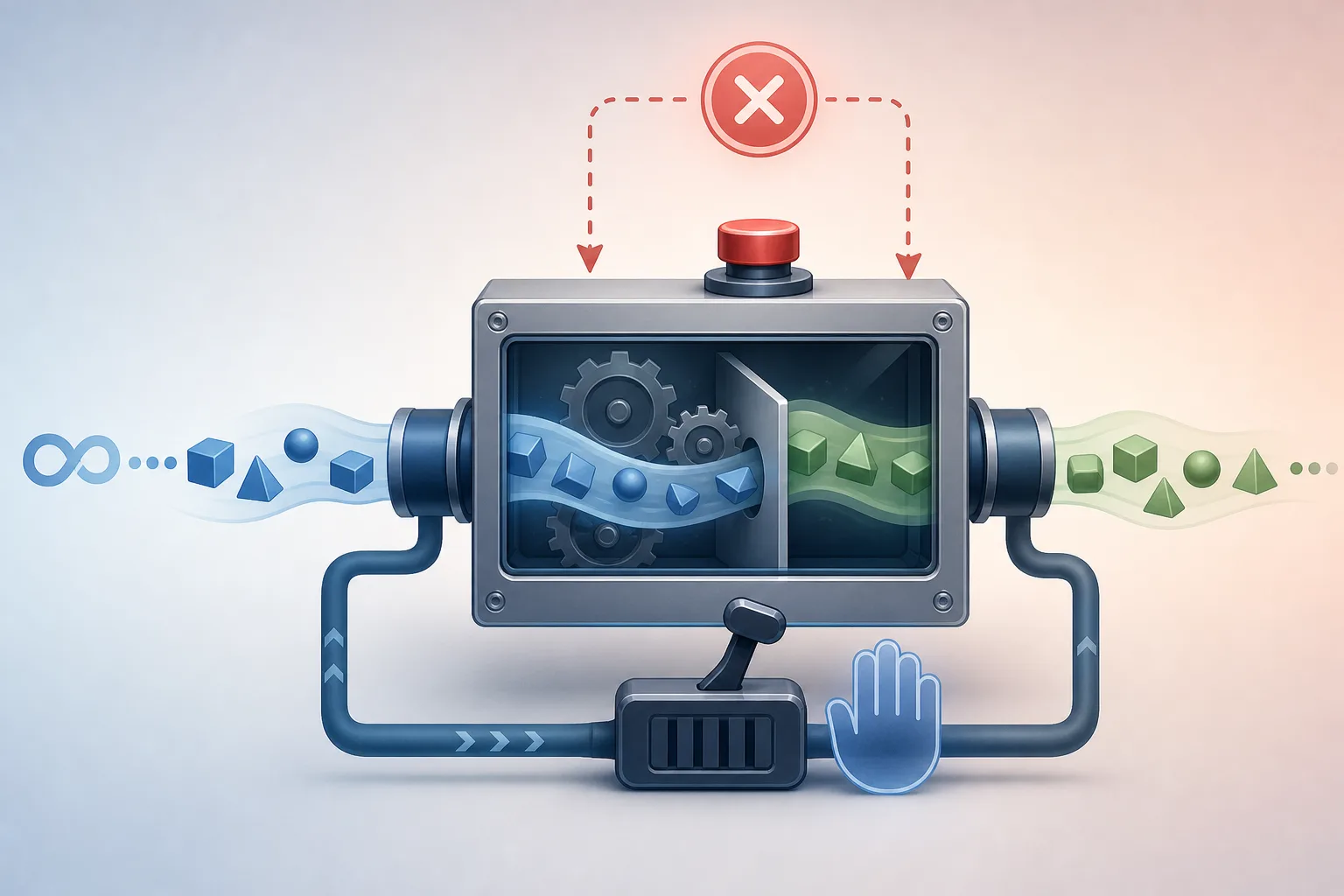
A Transform stream can look straightforward until it has to do three jobs at once: accept fast input without overrunning memory, cooperate with async-iterator producers or consumers, and stop immediately when some outside caller cancels the work. Those concerns are related, not separate. If you solve only one of them, the others usually reappear as stalled pipelines, duplicate chunks, or a process that keeps working after the result is no longer wanted.
This article uses Node’s documented stream behavior as the contract and a small custom Transform as the implementation boundary. The goal is not to build a stream framework of our own. It is to show how a cancellable transform can stay inside Node’s backpressure model, how an async iterator can feed it without flooding it, and how pipeline() can carry the failure outward so cancellation is visible and cleanup is automatic.
Why the obvious version breaks once input gets fast or cancellation arrives
A Transform stream looks simple until it has to do three jobs at once. It must transform each chunk, respect the stream’s buffering rules, and stop cleanly when some outside caller no longer wants the result. If you only solve the transformation part, the code can still fail under load. If you only solve cancellation, the stream can still overrun its writable side. If you only solve backpressure, the work can still continue after the result has been abandoned.
The failure mode is usually a mismatch in ownership. The producer decides when new values enter the stream, the Transform decides how those values become output, and the stream machinery decides when buffers are full. When those responsibilities blur together, the result is often a helper that keeps writing after the stream says it is full, or a cancellation path that stops a loop without telling the stream graph why it stopped. The official Node guidance is clear that Transform is a duplex stream and that _transform is the internal hook used to process input. The harder part is making the helper code obey the same contract instead of trying to outsmart it.
The implementation behind this article keeps the example small on purpose. It uses one custom Transform, one async-iterator feeding method, and one cancel method. The useful question is not whether that class looks elegant on its own. The useful question is whether it preserves output order, pauses when the writable side asks for a pause, and turns cancellation into a visible failure that pipeline() can clean up. That is the behavior the tests are built to check.
Attach pipeline() and its rejection handler before calling cancel(), including when testing an already-cancelled transform. The collector exposes only its writable stream and items; pipeline() is the single completion/error promise. The feeder observes writable completion before ending input and handles close as well as error while waiting for drain. Cancellation cannot interrupt arbitrary work inside a producer that is awaiting its next value; that source must also accept a cooperative abort signal when prompt interruption of its I/O is required.
import { Transform, Writable } from 'node:stream';
import { finished } from 'node:stream/promises';

function waitForDrain(stream) {
  return new Promise((resolve, reject) => {
    const cleanup = () => {
      stream.off('drain', drained);
      stream.off('error', failed);
      stream.off('close', closed);
    };
    const drained = () => { cleanup(); resolve(); };
    const failed = (err) => { cleanup(); reject(err); };
    const closed = () => failed(stream.errored || Object.assign(new Error('Stream closed before drain'), {
      code: 'ERR_STREAM_PREMATURE_CLOSE',
    }));
    stream.once('drain', drained);
    stream.once('error', failed);
    stream.once('close', closed);
    if (stream.destroyed) closed();
  });
}

export class CancellableTransform extends Transform {
  constructor(opts = {}) {
    super({ ...opts, objectMode: true });
    this._cancelled = false;
    this._cancelError = null;
  }

  cancel(err = new Error('Cancelled')) {
    if (this._cancelled) return;
    this._cancelled = true;
    this._cancelError = err;
    this.destroy(err);
  }

  async _transform(chunk, _enc, callback) {
    try {
      await Promise.resolve();
      if (this._cancelled) throw this._cancelError;
      this.push({ ...chunk, processed: true });
      callback();
    } catch (err) {
      callback(err);
    }
  }

  async runFromAsyncIterable(iterable) {
    // Observe failure immediately, even while the producer is awaiting a value.
    // Keep the result as a value until we can rethrow it to the caller.
    const completion = finished(this, { readable: false, cleanup: true }).then(
      () => null, (err) => err,
    );
    try {
      if (this._cancelled) throw this._cancelError;
      for await (const item of iterable) {
        if (this._cancelled) throw this._cancelError;
        if (this.destroyed) throw this.errored || new Error('Stream closed');
        if (!this.write(item)) {
          // A close without an error must also settle the wait for drain.
          await waitForDrain(this);
        }
      }
      this.end();
      const error = await completion;
      if (error) throw error;
    } catch (err) {
      if (!this.destroyed) this.destroy(err);
      await completion;
      throw err;
    }
  }
}

export function createCollector() {
  const items = [];
  const writable = new Writable({
    objectMode: true,
    write(chunk, _enc, callback) {
      items.push(chunk);
      callback();
    },
  });
  // pipeline() is the single completion/error promise; no second, easily
  // forgotten rejection is created by this collector.
  return { writable, items };
}
What the Transform owns, and what Node should keep owning
A Transform is not just a callback with a push() method. It is a duplex stream, which means the writable side accepts input and the readable side emits transformed output. That split matters because backpressure is enforced on the writable side through write() and drained through the drain event. The stream already knows when its own buffers are full. Custom code should not invent a second buffering system on top of that unless it has a very specific reason and a lot more testing.
In the implementation used for this article, the Transform owns one narrow responsibility: when _transform receives a chunk, it waits for one asynchronous turn, marks the chunk as processed, and pushes the result onward. It does not build a queue of pending chunks. It does not try to predict when the downstream consumer will recover. It simply relies on the stream contract to tell it when the writable side is ready for more. That makes the backpressure boundary visible rather than hidden inside helper state.
The same logic explains why pipeline() is the right composition primitive for this pattern. When a cancel or error happens, the connected streams should fail together and release their resources together. A helper that only stops the producer loop may prevent future writes, but it does not automatically unwind the rest of the graph. pipeline() gives the transform a single failure path that is observable to callers and easier to test.
SourcesNode.js: How to use streams (opens a new tab)Node.js: Backpressuring in streams (opens a new tab)
How the async-iterator producer respects backpressure instead of flooding the stream
The producer side in the example is an async iterator, not an old-style data event listener. That choice is important because the Node stream guides recommend async iterators as the standard way to work with readable streams. They are easier to read, easier to wrap in try/catch, and more naturally aligned with flow control than a listener that keeps firing whenever data appears. In this pattern, the producer loop becomes a sequence of explicit requests for the next chunk instead of a free-running push.
The helper method writes one item at a time into the Transform’s writable side. After each write, it checks the boolean return value. If write() returns false, the helper waits for drain before writing again. That is the whole backpressure contract in miniature. The stream itself decides when the queue is too full. The helper decides whether to respect that signal. Respecting it keeps the backlog bounded by the stream’s own threshold rather than by the producer’s speed.
This is also why the article does not treat async iterators as a replacement for stream behavior. They are a better input shape for this example, but they do not erase the need for write() and drain. The iterator makes the source readable. The stream contract makes the source safe. The combination is what lets the example stay simple without silently changing the buffering semantics that Node is already enforcing.
SourcesNode.js: How to use streams (opens a new tab)Node.js: Backpressuring in streams (opens a new tab)
Why cancellation needs an error, not just a stopped loop
Stopping the producer loop is not enough once the work has entered a stream graph. The caller needs to know that the operation was interrupted, and the connected streams need a clear signal that says the work did not complete normally. In the implementation behind this article, cancel() stores a cancelled state, remembers the first error, and destroys the stream with that error. That makes the cancellation visible to pipeline() and prevents the rest of the graph from pretending the operation simply ended on its own.
This distinction between end and abort matters. An ordinary end says the source has no more data. A cancellation error says the current work should not be treated as a success. Those are not interchangeable outcomes. If they are collapsed into the same result, downstream code loses the ability to distinguish a completed transform from a user-initiated stop. The example keeps those cases separate so the tests can assert the cancel reason instead of inferring success from an empty tail.
The cancel method is also idempotent. That is not an implementation flourish. It is the behavior that keeps duplicate teardown logic from masking the first failure reason. Real callers often issue more than one stop request, either because a UI has repeated cleanup or because a higher-level wrapper also tears down the stream. The first cancel should remain the source of truth.
SourcesNode.js: Backpressuring in streams (opens a new tab)Node.js: How to use streams (opens a new tab)
What the example proves, and what it deliberately leaves out
The test suite checks three concrete behaviors. First, the transform preserves input order and marks each object as processed. Second, the helper can feed a fast async iterator without flooding the stream, because it waits for drain whenever write() says the writable side is full. Third, a cancel request stops the run with the supplied error instead of allowing the work to finish as though nothing happened. Those are the properties the article can honestly claim from the implementation and the tests together.
The example does not claim more than that. It does not measure a production memory ceiling for arbitrary payloads, and it does not prove the exact behavior of a specific database, network socket, or file handle. It uses object mode and small JavaScript objects so the control flow remains visible. That is enough to verify the stream contract being discussed, but it is not a substitute for integration testing with the real data source and sink you plan to use.
The example also avoids inventing a hidden queue that would smooth over slow consumers. That omission is intentional. The point of the article is to keep Node’s own buffering rules in charge and to let the custom code focus on transformation and cancellation. If your application needs parallel transforms, retry policies, or a different error policy, those are separate design questions. Folding them into this pattern would make the stream contract harder to reason about, not easier.
How to choose this pattern, and where it stops being the right answer
Use this pattern when one component needs to accept async-iterator input, transform each value inside a stream, and stop promptly when an external caller cancels the work. If all you need is a simple mapping step, an async generator passed directly into pipeline() may be enough. If you only need to cancel before data reaches a stream, a separate abort signal at the source may be simpler. The extra Transform class is justified when the stream itself is the place where ownership should live.
Two edge cases are worth calling out because they reveal whether the design is actually deterministic. The first is an already-cancelled stream: the helper should reject immediately instead of processing one more item and stopping later. The second is repeated cancellation while work is in flight: the first reason should win, and the later call should not replace it. Those cases are not unusual corner cases. They are the situations that usually expose hidden race conditions.
The larger lesson is that backpressure and cancellation are linked, not separate checkboxes. A backpressure-aware stream that cannot be cancelled cleanly still wastes work. A cancellable stream that ignores write() return values still risks buffering too much. The practical design is the combination of both. Let Node own buffering through write(), drain, and pipeline(). Let the custom Transform own the application-specific transformation and abort state. That split keeps the code small enough to test and explicit enough to debug when one of the boundaries fails.
import test from 'node:test';
import assert from 'node:assert/strict';
import { Writable } from 'node:stream';
import { pipeline } from 'node:stream/promises';
import { setImmediate as nextTurn } from 'node:timers/promises';
import { CancellableTransform, createCollector } from './main.mjs';

async function* producer(count) {
  for (let index = 0; index < count; index++) yield { index };
}

test('processes input in order exactly once', { timeout: 3000 }, async () => {
  const tx = new CancellableTransform();
  const { writable, items } = createCollector();
  await Promise.all([pipeline(tx, writable), tx.runFromAsyncIterable(producer(25))]);
  assert.deepEqual(items, Array.from({ length: 25 }, (_, index) => ({ index, processed: true })));
});

test('empty input completes without missing the finish event', { timeout: 3000 }, async () => {
  const tx = new CancellableTransform();
  const { writable, items } = createCollector();
  await Promise.all([pipeline(tx, writable), tx.runFromAsyncIterable(producer(0))]);
  assert.deepEqual(items, []);
});

test('cancellation propagates to both promises and preserves the first reason', { timeout: 3000 }, async () => {
  const tx = new CancellableTransform();
  const { writable, items } = createCollector();
  const results = Promise.allSettled([pipeline(tx, writable), tx.runFromAsyncIterable(producer(10000))]);
  await Promise.resolve();
  const reason = new Error('user-cancel');
  tx.cancel(reason);
  tx.cancel(new Error('second-cancel'));
  for (const result of await results) {
    assert.equal(result.status, 'rejected');
    assert.equal(result.reason, reason);
  }
  assert(items.length < 10000);
  assert(tx.destroyed && writable.destroyed);
});

test('already-cancelled input rejects without requesting an item', { timeout: 3000 }, async () => {
  const tx = new CancellableTransform();
  const { writable } = createCollector();
  // Connect error handling BEFORE destroy(err), as required by Node streams.
  const pipeResult = Promise.allSettled([pipeline(tx, writable)]);
  const reason = new Error('already-cancelled');
  tx.cancel(reason);
  let requested = false;
  await assert.rejects(tx.runFromAsyncIterable((async function* () {
    requested = true; yield { index: 0 };
  })()), (err) => err === reason);
  assert.equal((await pipeResult)[0].reason, reason);
  assert.equal(requested, false);
});

test('slow sink applies backpressure instead of consuming the entire producer', { timeout: 3000 }, async () => {
  const tx = new CancellableTransform({ highWaterMark: 1 });
  let release, produced = 0;
  const received = [];
  const sink = new Writable({ objectMode: true, highWaterMark: 1, write(chunk, _enc, callback) {
    received.push(chunk.index);
    if (received.length === 1) release = callback;
    else callback();
  } });
  const complete = Promise.all([pipeline(tx, sink), tx.runFromAsyncIterable((async function* () {
    for (let index = 0; index < 50; index++) { produced++; yield { index }; }
  })())]);
  await nextTurn();
  const pausedAt = produced;
  await nextTurn();
  assert.equal(produced, pausedAt);
  assert(produced > 0 && produced < 50);
  release();
  await complete;
  assert.deepEqual(received, Array.from({ length: 50 }, (_, index) => index));
});

test('cancellation while waiting for drain closes the producer', { timeout: 3000 }, async () => {
  const tx = new CancellableTransform({ highWaterMark: 1 });
  let closed = false;
  const sink = new Writable({ objectMode: true, highWaterMark: 1, write() {} });
  const results = Promise.allSettled([pipeline(tx, sink), tx.runFromAsyncIterable((async function* () {
    try { yield* producer(1000); } finally { closed = true; }
  })())]);
  await nextTurn();
  assert.equal(tx.writableNeedDrain, true);
  const reason = new Error('cancel-during-drain');
  tx.cancel(reason);
  for (const result of await results) assert.equal(result.reason, reason);
  assert.equal(closed, true);
});

test('producer failure destroys the pipeline and is not swallowed', { timeout: 3000 }, async () => {
  const tx = new CancellableTransform();
  const { writable } = createCollector();
  const reason = new Error('source-failed');
  const results = await Promise.allSettled([pipeline(tx, writable), tx.runFromAsyncIterable((async function* () {
    yield { index: 0 }; throw reason;
  })())]);
  for (const result of results) assert.equal(result.reason, reason);
  assert(tx.destroyed && writable.destroyed);
});

test('a premature close while awaiting drain cannot hang', { timeout: 3000 }, async () => {
  const tx = new CancellableTransform({ highWaterMark: 1 });
  const sink = new Writable({ objectMode: true, highWaterMark: 1, write() {} });
  const results = Promise.allSettled([pipeline(tx, sink), tx.runFromAsyncIterable(producer(1000))]);
  await nextTurn();
  tx.destroy();
  for (const result of await results) {
    assert.equal(result.status, 'rejected');
    assert.equal(result.reason.code, 'ERR_STREAM_PREMATURE_CLOSE');
  }
});
SourcesNode.js: Backpressuring in streams (opens a new tab)Node.js: How to use streams (opens a new tab)