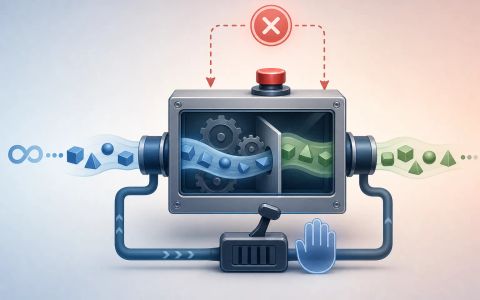
Why does `.pipe()` leave a failed Node stream chain open?
Compare `.pipe()` with `stream.pipeline()` in Node.js, then watch a failing Transform either leave the rest of the chain open or destroy every connected stream.
A stream chain that fails in the middle does not just have a correctness problem; it has an ownership problem. The source may still be readable, the destination may still be writable, and the Transform that saw the error may have already closed itself while the rest of the chain continues to exist. That is exactly the case this article isolates. The example does not try to model every stream behavior at once. It focuses on one ordinary failure: a Transform returns an error after a few chunks, and the surrounding code needs to know whether the other streams were cleaned up or left open.
Node’s own stream guide says `.pipe()` concatenates a readable stream to a writable or transform stream, but the same page also warns that `.pipe()` delegates error handling to the programmer. That warning matters here because the bad outcome is not merely an emitted error. In a connected chain, the important question is whether the source, transform, and destination all stop together. The supplied fixture compares that failure shape with `stream.pipeline()`, which is designed to forward errors and perform cleanup across the chain. The result is a practical distinction, not a stylistic one.
The article uses a controlled object-mode source instead of file I/O so the failure is deterministic and the observability is clear. In the success case, every chunk is transformed and written. In the failure case, the transform rejects one chunk, and the resulting state tells us whether each stream was destroyed or left open. That lets the reader answer the question from actual behavior rather than from a rule of thumb.
A failed Transform can leave a stream chain half alive
A stream chain that fails in the middle does not just have a correctness problem; it has an ownership problem. The source may still be readable, the destination may still be writable, and the Transform that saw the error may have already closed itself while the rest of the chain continues to exist. That is exactly the case this article isolates. The example does not try to model every stream behavior at once. It focuses on one ordinary failure: a Transform returns an error after a few chunks, and the surrounding code needs to know whether the other streams were cleaned up or left open.
Node’s own stream guide says `.pipe()` concatenates a readable stream to a writable or transform stream, but the same page also warns that `.pipe()` delegates error handling to the programmer. That warning matters here because the bad outcome is not merely an emitted error. In a connected chain, the important question is whether the source, transform, and destination all stop together. The supplied fixture compares that failure shape with `stream.pipeline()`, which is designed to forward errors and perform cleanup across the chain. The result is a practical distinction, not a stylistic one.
The article uses a controlled object-mode source instead of file I/O so the failure is deterministic and the observability is clear. In the success case, every chunk is transformed and written. In the failure case, the transform rejects one chunk, and the resulting state tells us whether each stream was destroyed or left open. That lets the reader answer the question from actual behavior rather than from a rule of thumb.
- The reader is a Node.js developer who already knows streams well enough to wire a Readable to a Transform and a Writable.
- The trigger is a Transform callback error in the middle of an otherwise ordinary file-processing chain.
- The question is not how to build a stream pipeline from scratch; it is why `.pipe()` can leave part of the chain alive after a failure.
- The outcome is a direct comparison that shows when `pipeline()` is the safer default because it destroys the full chain on error.
import { Readable, Transform, Writable } from 'node:stream';
import { pipeline } from 'node:stream/promises';

function makeChain(chunks, failOn) {
  let index = 0;
  const received = [];

  // A one-item high-water mark prevents this source from eagerly ending before
  // the transform gets a chance to reject a later item.
  const source = new Readable({
    objectMode: true,
    highWaterMark: 1,
    read() {
      if (index === chunks.length) {
        this.push(null);
        return;
      }
      this.push(chunks[index++]);
    },
  });

  const transformer = new Transform({
    objectMode: true,
    highWaterMark: 1,
    transform(chunk, _encoding, callback) {
      if (chunk === failOn) {
        callback(new Error(`transform rejected: ${String(failOn)}`));
        return;
      }
      callback(null, String(chunk).toUpperCase());
    },
  });

  const destination = new Writable({
    objectMode: true,
    write(chunk, _encoding, callback) {
      received.push(chunk);
      callback();
    },
  });

  return { source, transformer, destination, received };
}

function state(chain) {
  return {
    output: chain.received,
    sourceDestroyed: chain.source.destroyed,
    sourceEnded: chain.source.readableEnded,
    transformDestroyed: chain.transformer.destroyed,
    destinationDestroyed: chain.destination.destroyed,
    destinationFinished: chain.destination.writableFinished,
  };
}

// This deliberately uses ordinary .pipe(). Its error listener prevents an
// unhandled-error crash, but it does not implement cleanup for the other ends.
export async function processWithPipe(chunks, failOn) {
  const chain = makeChain(chunks, failOn);
  const error = await new Promise((resolve) => {
    chain.transformer.once('error', resolve);
    chain.source.pipe(chain.transformer).pipe(chain.destination);
  });

  return { error, ...state(chain) };
}

// This is the application-facing alternative for a connected stream chain.
export async function processWithPipeline(chunks, failOn) {
  const chain = makeChain(chunks, failOn);
  let error = null;

  try {
    await pipeline(chain.source, chain.transformer, chain.destination);
  } catch (caught) {
    error = caught;
  }

  return { error, ...state(chain) };
}
The controlled fixture makes the chain failure reproducible
The implementation builds the same three-stage shape in both branches: a `Readable`, a `Transform`, and a `Writable`. The source pushes a small array of strings one item at a time. The Transform converts each chunk to uppercase until it sees the designated failure value, then it calls back with an error. The Writable simply records whatever it receives. That is enough to answer the article’s question without involving the filesystem, a socket, or any unrelated buffering behavior. The code does not need to pretend that a file stream is special; the ownership issue exists in any connected chain.
The deliberate choice of object mode keeps the proof readable. It removes byte-size noise and lets the tests talk about exact chunks rather than buffer slicing. The helper also captures the stream state that matters after the operation: whether the source, transform, and destination were destroyed, whether the source had ended, and whether the destination finished. Those state flags are not decorative. They show whether the chain stopped as a coordinated unit or whether only the failing stage shut itself down. That distinction is what `.pipe()` often leaves ambiguous when it is used on its own.
The success path uses the same fixture with a non-matching failure marker. That control run matters because the article is not trying to prove that the transform can fail; it is trying to prove that the chain can also complete normally. Without the success case, a reader might misread the failure test as a general condemnation of streams rather than as a diagnosis of error propagation and cleanup.
- `processWithPipe()` wires the chain with `.pipe()` and listens for the Transform’s error so the test can observe the result without crashing the process.
- The source is a `Readable` in object mode with a one-item high-water mark, the Transform uppercases each chunk, and the Writable collects the output array.
- When the selected chunk equals the failure marker, the Transform calls back with an error instead of pushing transformed data.
- Because the fixture is deterministic, the same input produces the same success or failure state every time.
`pipeline()` does the cleanup that `.pipe()` leaves to you
The contrast is easiest to see in the repaired branch. Instead of chaining `.pipe()` calls and hoping the error handlers cooperate, `processWithPipeline()` passes the same three streams to `stream.pipeline()`. When the Transform rejects a chunk, the promise rejects, and the function records the resulting state after Node has had the chance to tear the chain down. The important point is not that an error exists; both branches see the error. The important point is that `pipeline()` makes the rest of the chain part of the same failure response.
That cleanup behavior matters because it changes the ownership of the downstream and upstream resources. In the `pipeline()` branch, the test observes the source, transform, and destination as destroyed after the error. In the `.pipe()` branch, the failing Transform is destroyed, but the surrounding streams remain open. Those open ends are the thing the Node guide warns about when it says `.pipe()` leaves error handling to the programmer. If the application never closes the other ends, the chain is not just failed; it is still occupying resources that the caller likely expected to be gone.
This is also why backpressure and cleanup should not be conflated. Backpressure explains how data moves when the consumer is slower than the producer. The question here is different: what happens when a stage throws? A stream can respect backpressure perfectly and still be mishandled after a failure if the chain is not torn down. `pipeline()` solves the failure response, not the flow-control policy.
- `pipeline()` returns a rejected promise when the Transform fails, so the caller gets the error in the same control flow it used to start the chain.
- The repaired branch destroys the source, transform, and destination, which is the behavior the article wants the reader to notice.
- The test also shows that a successful `pipeline()` call finishes the destination and preserves every transformed chunk.
- This is a cleanup guarantee, not a backpressure guarantee; the backpressure topic is related but separate.
SourcesNode.js: How To Use Streams (opens a new tab)Node.js: Backpressuring in Streams (opens a new tab)
Why a transform error listener is not enough
A common incomplete repair is to attach an error listener to the Transform and assume that this is the whole job. That may prevent an unhandled exception, but it does not solve the lifecycle problem. In the fixture, the transform error is already visible in both branches. What differs is whether the other streams are destroyed too. If the source keeps reading or the destination stays open, the application still has a half-attached pipeline after the error has been reported.
That distinction is why the test records both the output and the destruction state. The partial output array tells you how far the chain got before failure. The destruction flags tell you whether the failure response was holistic. A stream chain can fail after writing the first transformed chunk and still be wrong if the source remains alive. That is the exact trap the article is trying to surface: a surfaced error is not the same thing as a completed cleanup.
The negative case is also useful because it limits the claim. The article is not saying every `.pipe()` call is broken or that `.pipe()` has no legitimate uses. It is saying that when a chain must be closed as a unit after a failure, `.pipe()` by itself does not give you that guarantee. If the application is responsible for closing the other ends, the application must do that work explicitly. If it wants Node to own that cleanup, `pipeline()` is the simpler boundary.
- The `.pipe()` branch needs an explicit error listener because otherwise the process would crash on an unhandled stream error, but that listener does not clean up the rest of the chain.
- The test observes a partial output array, which proves that some chunks reached the Writable before the failure.
- The source staying open is a failure condition in its own right; it means the producer and consumer are no longer coordinated.
- An incomplete fix would be to add only `transform.on('error', ...)` and stop there. That handles the symptom, not the chain ownership problem.
What the tests prove, and what they do not
The tests make three separate claims. First, they prove that the happy path still works: when the Transform does not fail, `pipeline()` preserves all chunks and finishes the Writable. Second, they prove that `pipeline()` surfaces the transform error and destroys the whole chain. Third, they prove that `.pipe()` alone does not perform that broader cleanup, even though the transform error is still observable. Keeping those claims separate matters because it stops the article from overpromising a single behavior for two different APIs.
The test suite also keeps one important limit visible: it does not try to measure kernel resources, file descriptors, or actual memory leaks in a production workload. Instead, it uses the stream objects’ own state flags as a direct signal of whether the chain has been torn down. That is enough for the article’s question because the reader is trying to choose the right Node API for error ownership, not to benchmark throughput. The fixture is therefore evidence of lifecycle behavior, not a performance study.
The practical decision rule is simple. If you are wiring a small chain and you will manually close every participant on every failure path, `.pipe()` can still be part of that design. If you want the chain itself to be treated as one unit that should clean up on error, `pipeline()` is the safer default. The article’s value is not that it bans `.pipe()`; it shows why `.pipe()` is incomplete for the specific failure mode the reader is trying to prevent.
- The success test shows the ordinary case: every input chunk is transformed and the destination finishes normally.
- The failure tests show the boundary: the same chain does not stay open when `pipeline()` owns the cleanup, but it does stay open when `.pipe()` is used without additional teardown.
- This pattern is most relevant when the upstream source is expensive to keep alive, the downstream sink should not keep accepting writes, or the application wants a single completion/error boundary.
- The fixture does not prove file-descriptor behavior for every real source type; it proves the ownership contract that the application code sees.
import test from 'node:test';
import assert from 'node:assert/strict';
import { processWithPipe, processWithPipeline } from './main.mjs';

test('processWithPipeline delivers every chunk when the transform does not fail', async () => {
  const result = await processWithPipeline(['red', 'blue', 'green'], 'missing');

  assert.equal(result.error, null);
  assert.deepEqual(result.output, ['RED', 'BLUE', 'GREEN']);
  assert.equal(result.destinationFinished, true);
});

test('processWithPipeline propagates a transform failure and destroys every connected stream', async () => {
  const result = await processWithPipeline(['good', 'bad', 'later'], 'bad');

  assert.equal(result.error?.message, 'transform rejected: bad');
  assert.deepEqual(result.output, ['GOOD']);
  assert.equal(result.sourceDestroyed, true);
  assert.equal(result.transformDestroyed, true);
  assert.equal(result.destinationDestroyed, true);
});

test('processWithPipe reports the transform error but leaves upstream and downstream open', async () => {
  const result = await processWithPipe(['good', 'bad', 'later'], 'bad');

  assert.equal(result.error?.message, 'transform rejected: bad');
  assert.deepEqual(result.output, ['GOOD']);
  assert.equal(result.transformDestroyed, true);
  assert.equal(result.sourceDestroyed, false);
  assert.equal(result.sourceEnded, false);
  assert.equal(result.destinationDestroyed, false);
  assert.equal(result.destinationFinished, false);
});
SourcesNode.js: How To Use Streams (opens a new tab)Node.js: Backpressuring in Streams (opens a new tab)
Use the API that owns the failure, not just the data flow
The most useful thing this comparison shows is that error propagation and cleanup are separate concerns. `.pipe()` connects streams and lets data flow, but it does not by itself answer the question of what happens to the other ends when a Transform fails. `pipeline()` answers that question by treating the whole chain as one unit of work. That is why the article uses the same fixture twice: once to show the data path, and once to show the failure path.
For a reader debugging a failed Node stream chain, the distinction is practical. If the chain must stop together, do not rely on a transform error listener alone and assume the rest of the source and sink will disappear. The right next step is to use `pipeline()` or to add equivalent teardown logic yourself and verify the result. The article’s tests show the failure shape plainly: one API leaves open ends, and the other closes them. That is the decision the reader needs, and it is the reason the two stream helpers are not interchangeable.
The remaining limit is the same one that applies to most stream guidance: a local fixture proves the contract you exercised, not every possible source, sink, or runtime shape. But in this case the contract is the important part. When a Transform fails, the chain should either be cleaned up as a unit or be cleaned up manually with equal care. The article shows why `pipeline()` is the easier way to make that happen.
- `pipeline()` is the safer boundary when the app needs one error path and one cleanup path for the entire chain.
- `.pipe()` still has a place when the application is explicitly managing teardown itself.
- The observable difference in the fixture is the state after the failure, not the presence of an error event alone.
- A failed chain that still has open ends is the wrong outcome for most file-processing workflows.